About Me
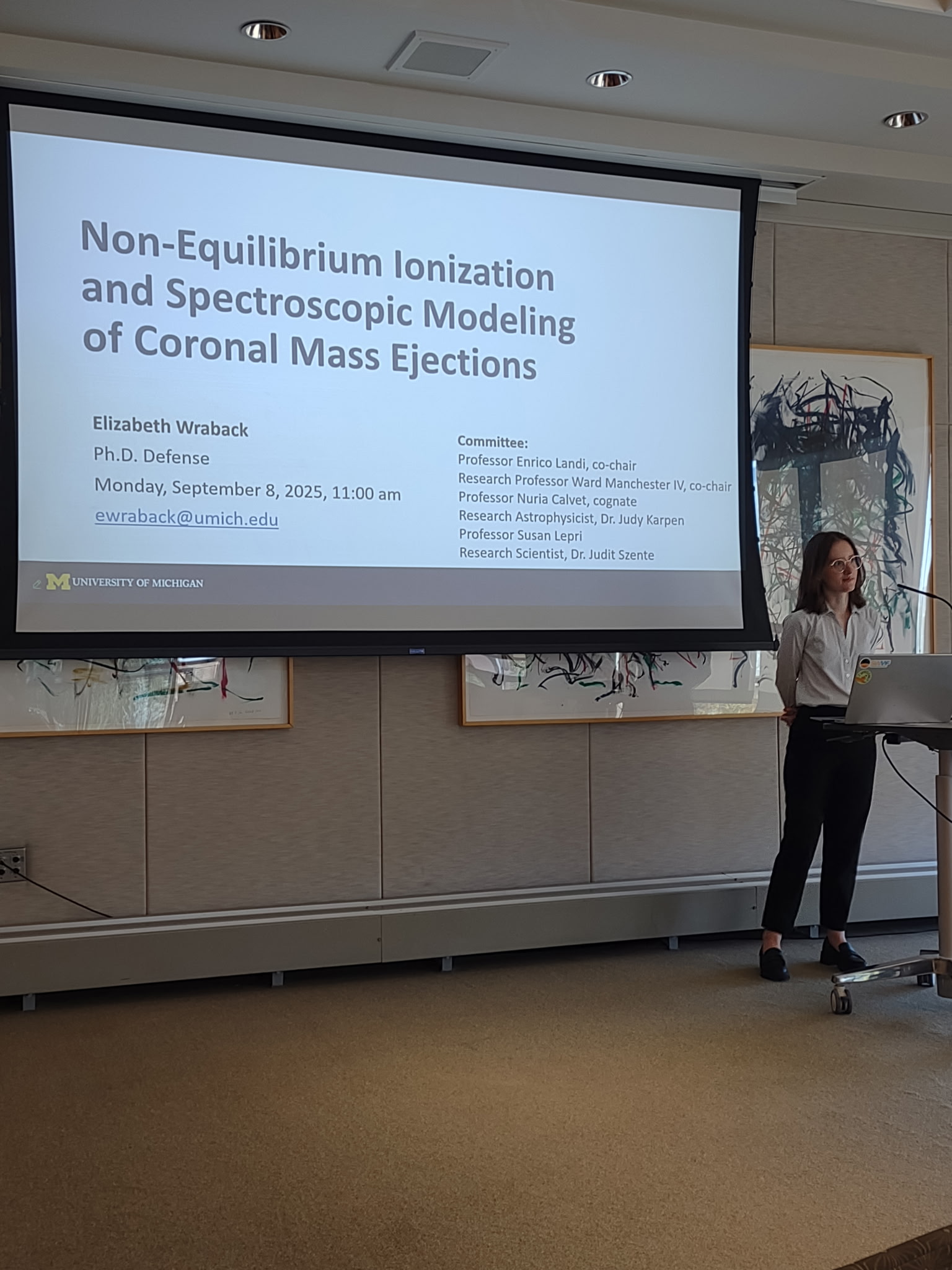
My research focuses on how we can utilize multiple types of observations and modeling to connect observations from the low solar corona through the heliosphere to those made near 1 AU. I focus on eruptive events and their pre-eruptive structures to improve space weather models.
My expertise lies in the intersection of observations and modeling, and how we can connect domains that are spatially very distant.
Outside of work, you will likely find me in a ballet studio, either taking class and rehearsing or teaching. I also love to knit (most likely you will see me in a hand-knit item) and reading!
Education:
Ph.D. in Climate and Space Sciences from the University of Michigan
Thesis title: Non-equilibrium ionization and spectroscopic modeling of coronal mass ejections
B.Sc. in Physics and Astronomy from the University of Maryland
Graduated with high honors in Physics and high honors in Astronomy
CME Modeling
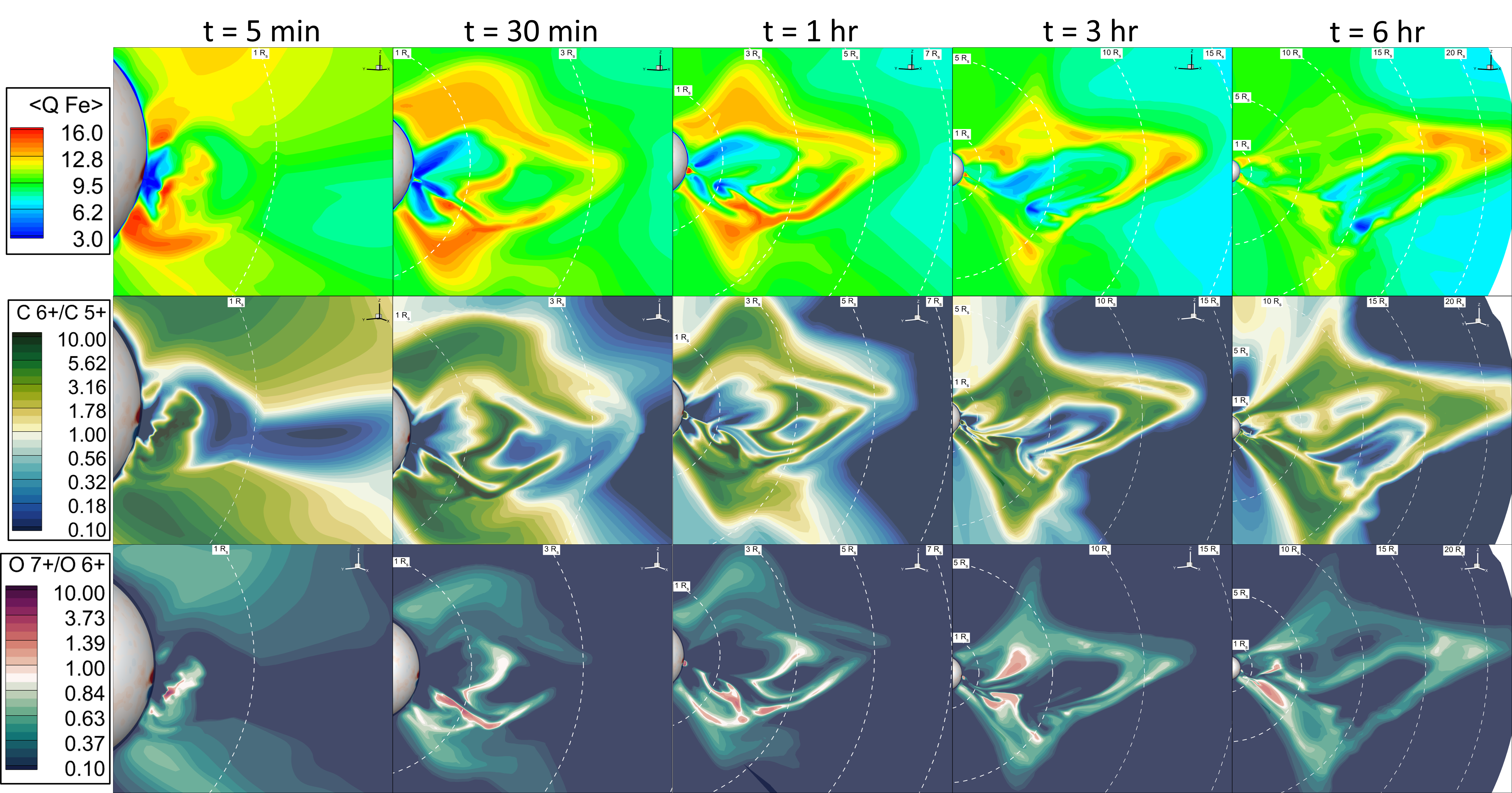
During my Ph.D., I simulated the April 9th, 2008 CME ("Cartwheel CME") with the Alfven Wave Solar atmosphere Model (AWSoM; van der Holst et al. 2014, 2022). This is the first CME that includes a self-consistent calculation of the non-equilibrium ionization charge states throughout the simulation domain and in the EUV spectral synthesis.
AWSoM Comparison with Hinode/EIS Observations
In this work, we used the high-resolution Hinode/EIS observations to compare with the synthetic NEI EUV spectra to understand how well AWSoM captures CME thermodynamics at 1.1 Rs. Our main conclusions include:
AWSoM's thermodynamics compare well with observables at 1.1 Rs.
The inclusion of NEI effects is extremely important for CMEs, due to their rapid changes in density and temperature.
See Wraback et al. 2025a for more information!
Energy Budget Evolution
We continue to propagate the CME through the heliosphere to understand how, where, when, and why energy is being transferred in the CME, especially in regions where we lack observations (i.e. "the Middle Corona"). Our main conclusions include:
When the Gibson-Low flux rope is inserted into the active region, the magnetic energy in the system increases by 1.04 × 10^32 erg. It then quickly drops off as the CME converts about 70% of the magnetic energy into thermal and kinetic energy through magnetic dissipation in the compressive wave.
About 30% of the total energy in the system is lost to radiation and is observed in the EUV and X-ray emission.
The sheath promotes Alfvén wave dissipation at the CME front, while reconnection from the detaching flux rope causes heating at the back of the CME.
In the prominence, the radiative cooling rate remains large beyond 10 Rs, keeping the electron and proton temperature close to the temperature floor in the model. These cold temperatures have important implications for low-ionization state material being observed in situ.
The primary cooling mechanism is the adiabatic expansion of the material, which significantly decreases the density by ≈3 hr. The drop-off in density also has important implications for heavy ion freeze-in distances in CMEs.
See Wraback et al. 2025b for more information!
Charge State Evolution
In this final paper of the series, we investigate the charge state evolution and how the ionization and recombination rates are affected by the energy transfer discussed in Wraback et al. 2025b. Our main conclusions include:
The low-ionization prominence material survives to 1 au, due to the high radiative cooling rate, which keeps the electron temperature low, preventing ionization, and allows the charge states to freeze-in between 4 and 6 Rs with a very low ionization distribution, while the higher ionization states do not freeze-in.
Prominence material makes up ≈10% of the cross-sectional area of the CME and therefore is less likely to be observed in situ, thus explaining the small fraction of ICMEs observed in situ carrying prominence plasmas.
The hottest material comes from the initial eruption, which rapidly increases its electron temperature in the low SC, and this material freezes in by 7.0 Rs.
We show that between the EIS slit location (1.1 R⊙) and the freeze-in height, there is a significant amount of unobserved charge state evolution that would be lost without the use of models.
See Wraback et al. 2026 for more information!
Coronal Cavities
In my postdoc, I am investigating coronal cavities using ground-based and space-based observatories and MHD modeling. Currently, I am using the DKIST/CryoNIRSP data to measure the Stokes V in the coronal cavity and prominence plasma (paper in preparation for submission), as well as prepare for UCoMP to come back online and next-generation ground-based observatories, like COSMO.
Publications
Wraback, E.M., Manchester, W.B., Landi, E., \& Szente, J. 3D Non-Equilibrium Ionization and Spectroscopic Modeling of Coronal Mass Ejections III - Charge State Evolution. (2026) ApJ. 996, 65. doi:/10.3847/1538-4357/ae1a7a
Wraback, E.M., Manchester, W.B., Landi, E., & Szente, J. 3D Non-Equilibrium Ionization and Spectroscopic Modeling of Coronal Mass Ejections II - CME Energy Budget. (2025) ApJ. 995, 105. doi:10.3847/1538-4357/ae18a1
Wraback, E.M., Landi, E., Manchester, W.B., & Szente, J. 3D Non-Equilibrium Ionization and Spectroscopic Modeling of Coronal Mass Ejections I - Comparison with Hinode/EIS Observations. (2025). ApJ 980, 30. doi:10.3847/1538-4357/ada7e8
Wraback, E.M., Landi, E., & Manchester, W.B. Using the Cartwheel CME to Predict Off-Limb Observations of CMEs for New and Upcoming UV and EUV Spectrometers. (2024). ApJ 970, 182. doi:10.3847/1538-4357/ad6d58
Wraback, E.M., Landi, E., & Manchester, W.B. EIS Spectral Atlas of Cool Prominence Material in CME Core. (2024). ApJ. 970, 182. doi:10.3847/1538-4357/ad625f
Wraback, E.M., Hoffmann, A.P., Manchester, W.B., Sokolov, I.V., van der Holst, B., \& Carpenter, D. Simulating Compressive Stream Interaction Regions during Parker Solar Probe's First Perihelion using the Stream-Aligned Magnetohydrodynamics. (2024). ApJ. 962, 2. doi:10.3847/1538-4357/ad21fd
Service
Teaching:
Outreach:
Equity & Inclusion:
Contact
Please contact me! I am always looking for new collaborations and opportunities.
Email: ewraback@ucar.edu